Livestock project & herd records
Keep the record book as the season happens.
Weights, feed, work, money, photographs, and health — entered on the phone in the barn, and totaled for you when the book is due. Your county’s own form, laid out page by page, for the five programs it covers so far.
Free for up to two exhibitors, one active animal each.
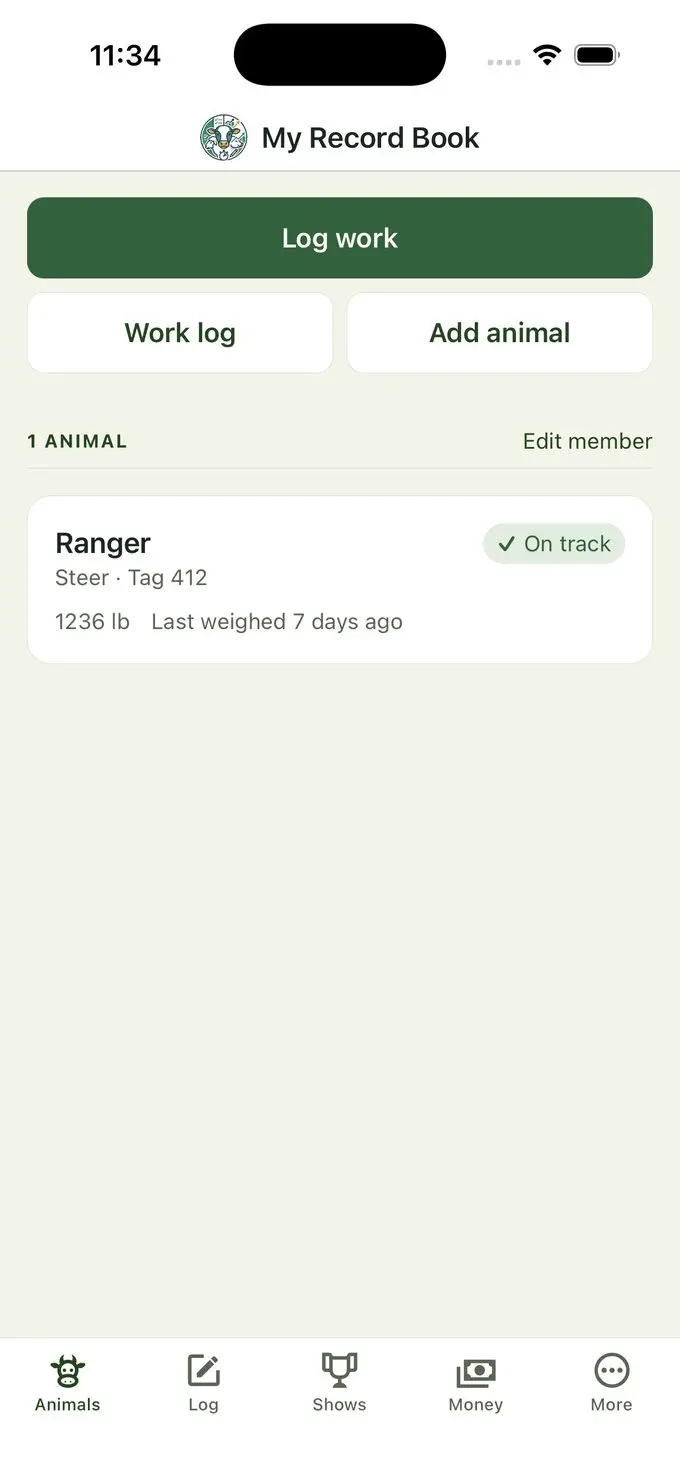
Works out in the barn
Records are kept on the phone, so a weigh-in logs at the scale house whether there is signal or not.
Your records stay on the phone
No account, no analytics, and no advertising. Only three things go online — the published lists, sponsor logos, and a subscription check — and none of them carries a record of yours.
Free for two exhibitors
Up to two exhibitors, one active animal each, and every record they keep. A yearly subscription adds more exhibitors and animals, and makes the finished record book and reports.
Built from real record books
Eleven books from five programs, each laid out after that office’s own edition — because no two of them agree.
The animal is the easy part.
Feed receipts go in a drawer. Weights end up on a whiteboard, a phone note, and the back of a feed tag. Then the book is due, and a season of real work has to be reconstructed from memory on a kitchen table at ten o’clock at night.
None of that is a record-keeping problem worth failing over. It is a problem of having nowhere sensible to put a number the moment you have it.
One place for everything the book asks for
Enter it once, on the day it happens, in about the time it takes to shut a gate.
Weights and gain
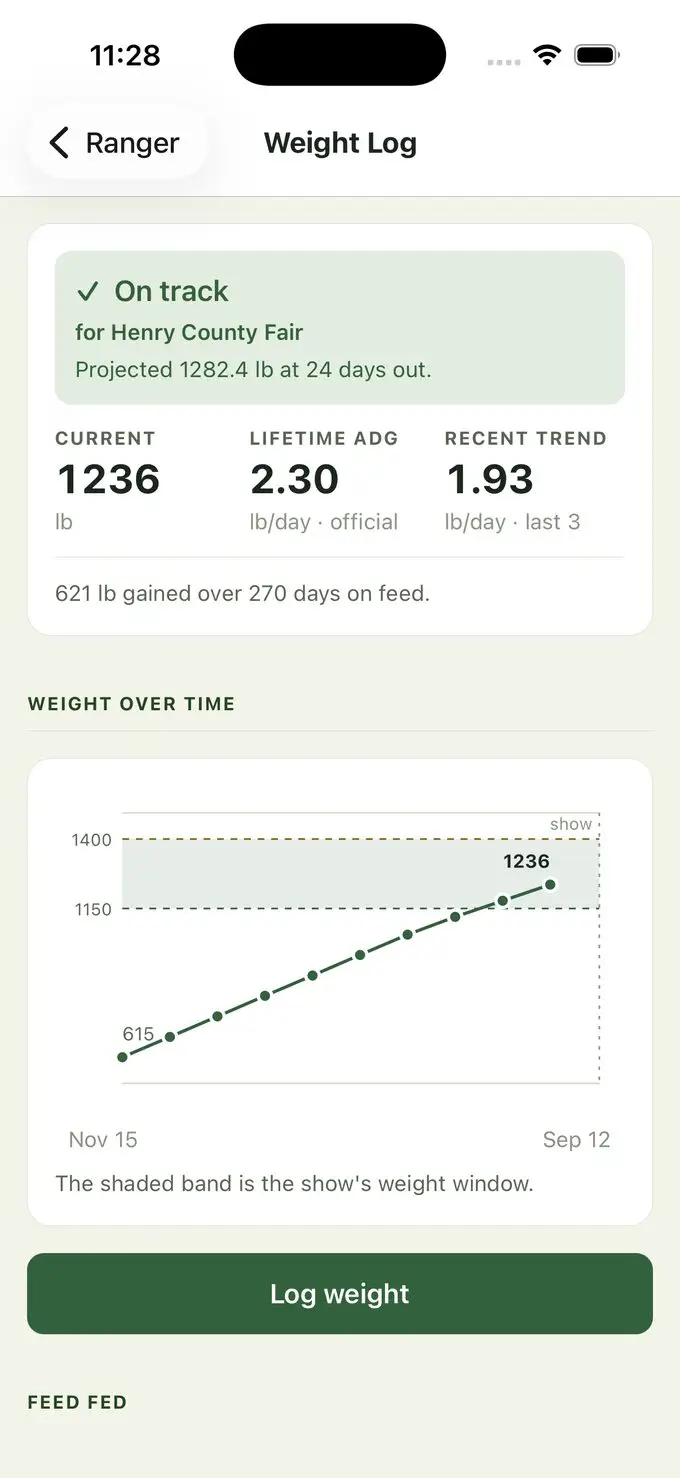
Log a weight in seconds and record how it was taken. Lifetime average daily gain is the figure the book asks for, a recent trend warns early, and the show’s weight window is drawn behind the line.
Feed and money
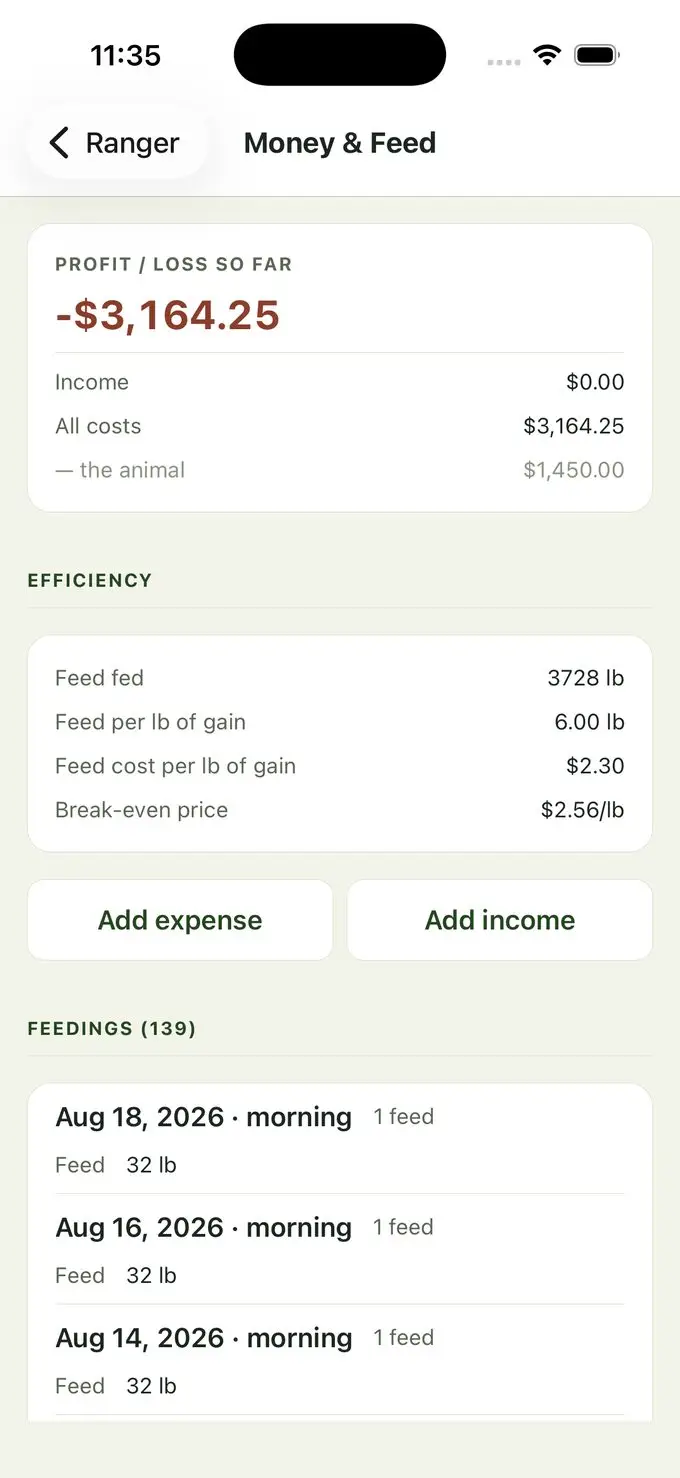
Every receipt, split across the animals that shared it. Cost of gain, break-even, and depreciation, totaled to the cent, because a record book that does not foot gets marked down.
Milk and eggs
A dairy cow’s lactation and a laying flock’s day, kept in the units they were measured in. A pen of rabbits or broilers is one project with a head count.
Work, photographs, and health
Hours and what was done, with photographs attached. Treatments with the meat, milk, and egg withdrawal dates worked out from the label — never a ruling on whether you may show.
The show directory
Tennessee and the national jackpots, published as a list the app downloads. A show’s date and weight window are filled in for you to confirm. Free, on every version.
Contacts
Buyers, supporters, feed stores, leaders, and veterinarians in one household list, with the buyer pipeline, letter dates, and follow-ups on top. It used to be called the buyer list.
What it adds up to
Show what the work actually took.
A season disappears into single days. Forty minutes before school. An hour after practice. A Saturday morning rinsing and a Sunday afternoon walking. Nobody remembers it, and nobody outside the barn ever sees it.
Because every session, weight, and receipt is dated, the app can total the season honestly — hours, days, pounds, and dollars — and put a real number on what went in.
- For reporting. Hours and totals a record book, an application, or a scholarship form asks for, already added up.
- For marketing themselves. A buyer deciding what to bid is far more moved by 96 logged hours than by a good haircut on sale day.
- For everyone else. A plain answer to “how hard can it be?” that a grandparent, a teacher, or a first-time family can actually picture.
Hours logged
Across 119 separate work sessions
Days on feed
First weigh-in to the latest one
Cost per pound of gain
Feed cost against pounds actually put on
Total gain
615 lb in, 1,236 lb at the last weigh-in
Figures from an example project, shown to illustrate the arithmetic.
Gain and projections
Know whether you will make weight — while there is still time to do something about it.
Every weigh-in updates two figures. Lifetime average daily gain is the official one that goes in the book. Recent trend looks at the last few weigh-ins only, and it is the one that tells you something has changed.
The chart draws your show’s weight window as a band and runs the timeline out to show day, so the question you actually care about — will this animal land inside it — is answered without reading a single number.
When the projection falls short, the app states the arithmetic and the gap in plain pounds. What to change about the feeding program is a decision for the exhibitor, their parent, their leader, or their vet. The app does not offer an opinion, and it never will.
Feed and money
What the gain actually cost.
Log feed purchases and what was fed, and the app divides cost by pounds put on. That single figure — cost per pound of gain — is the one that turns a project from an animal into a business.
Every amount is stored in whole cents from end to end, because feed cost gets divided by pounds and multiplied back out, and that is exactly the pattern that accumulates rounding error. A record book that does not foot gets marked down.
Nutrition figures are never guessed. The app seeds feed brands and product names but leaves protein, fat, and fiber blank on purpose — a stale number baked into an app is worse than an empty field, because a student would copy it into a book and it would be wrong with no way to tell.
The part that matters when the book is due
Built to be turned in.
A season of tidy records is worth nothing if it does not come out in the shape your program asks for. The app lays out a real book — the same headings, the same categories, the same order — as a PDF you can print, with spreadsheet (CSV) files if you would rather work in one. Some programs, St. Lucie County among them, want the final book handwritten, so there the app prints a work copy to draft from — check with your leader before you print one to hand in.
Five programs and eleven books so far: Henry County, Tennessee (goat, swine, lamb, and steer); Johnston County, North Carolina (goat, heifer, lamb, and swine); Georgia statewide (market swine, in three grade levels); St. Lucie County, Florida (market steer and market swine); and Michigan statewide (Intermediate). Each is laid out after that office’s own edition, not produced or approved by it, and a species with no book of its own uses the detailed report.
Choosing a book and seeing what it still needs is free. Making the finished book is part of the subscription.
Before you turn it in
The app flags what is missing, so nothing is discovered the night before.
- Pages you still have to write yourself
- A table that runs past the office’s own sheets
- Show results still to record after the show
- Thank-you letters still owed to a buyer
- Cover details the app has nothing for yet
It tells you what is missing. It never fills anything in.
The rule the whole app is built around
The app does the arithmetic. The student does the thinking.
This is a better tool than a shoebox for keeping records. It is not, and will never be, a way around the work the record book exists to teach.
What it will do
- Organize, prompt, remind, and total
- Print the frame of a business letter where a county book asks for one, with the body left blank for you
- Track when each letter was sent, and flag a buyer who has not been thanked
- Supply the structure and prompts your county’s template asks for
- Flag what is still missing before you turn it in
What it will not do
- Write a project story, a reflection, or a goal
- Write a buyer’s letter or a thank-you letter
- Suggest what to say to anyone
- Tell you what to change about a feeding program
- Hand a student a single sentence a judge is scoring
Every sentence of a story, a reflection, a goal, or a letter is typed by the exhibitor. Those are the parts a judge is grading, and they are the point of keeping the book.
Market animals and herds alike
Not only for a project animal.
Gain against feed cost is gain against feed cost whether the animal is going to a county fair or staying on the place. The app was shaped alongside youth exhibitors, and it works just as well for a family raising a market animal or a working operation watching what a pen is costing to put weight on.
Breeding records are first-class rather than an afterthought — bred, due, birthed, and rebred, year after year — and a dairy cow’s milk and a laying flock’s eggs are kept too, which is what makes the app worth opening in a month with no show in it.
Steer
Heifer
Dairy Cattle
Swine
Lamb
Goat

Rabbit
Poultry
Other
Start free. Pay when it has earned it.
Free for up to two exhibitors, one active animal each, with no time limit and no advertising. A yearly subscription adds more exhibitors and animals, and makes the finished record book and reports — twelve months from the day you start, not a show season. The App Store shows the price for your country.
Questions families ask first
Yes, and it was designed for exactly that. Every screen accepts a past date — weights, feed purchases, expenses, income, and work sessions all backfill. Nothing assumes you are filling it in live, because most people adopt a record-keeping app halfway through a project year rather than on day one.
Yes. Records are kept in a database on the phone, so logging a weight at the scale house works with no bars and no Wi-Fi. Refreshing the published lists and checking the subscription need a connection; a failed refresh leaves the copy you already have, and a phone that has checked the subscription before remembers the answer.
No, and that is deliberate. The app supplies the structure and the prompts your county’s template asks for, and where a book asks for a letter it prints the frame of one, but every sentence is written by the exhibitor. Anything a judge grades on the student’s own thought or writing stays the student’s.
On your device. There is no account, no server holding your records, no cloud sync, no advertising, and no analytics. Three things go online: the published show, feed, and breeder lists; sponsor logos in the breeder directory; and a subscription check that carries an anonymous identifier and what was bought. None of them carries a record of yours.
Start the season with the records already handled.
One month free when you start the subscription. It renews at the App Store price each year unless you cancel at least 24 hours before. Cancel and you keep the free version, with everything you have already recorded.